
750,000+ Happy Teachers & School Districts

300,000+ ★★★★★
30,000+ Resources for all K-2 Standards

$33.00 Original price was: $33.00.$25.00Current price is: $25.00.
 Great resource
This resource was incredibly helpful and well-designed. It saved me so much planning time and kept my students engaged from start to finish. The materials were clear, organized, and easy to use, and the activities supported meaningful learning. I really appreciate the thought and care put into creating this—highly recommend! – Lindsey M.
Really helpful
This has been really helpful for my students who I cannot seem to keep busy, no matter how hard I try. Thank you for taking one thing off the long to-do list! – Taylor M.
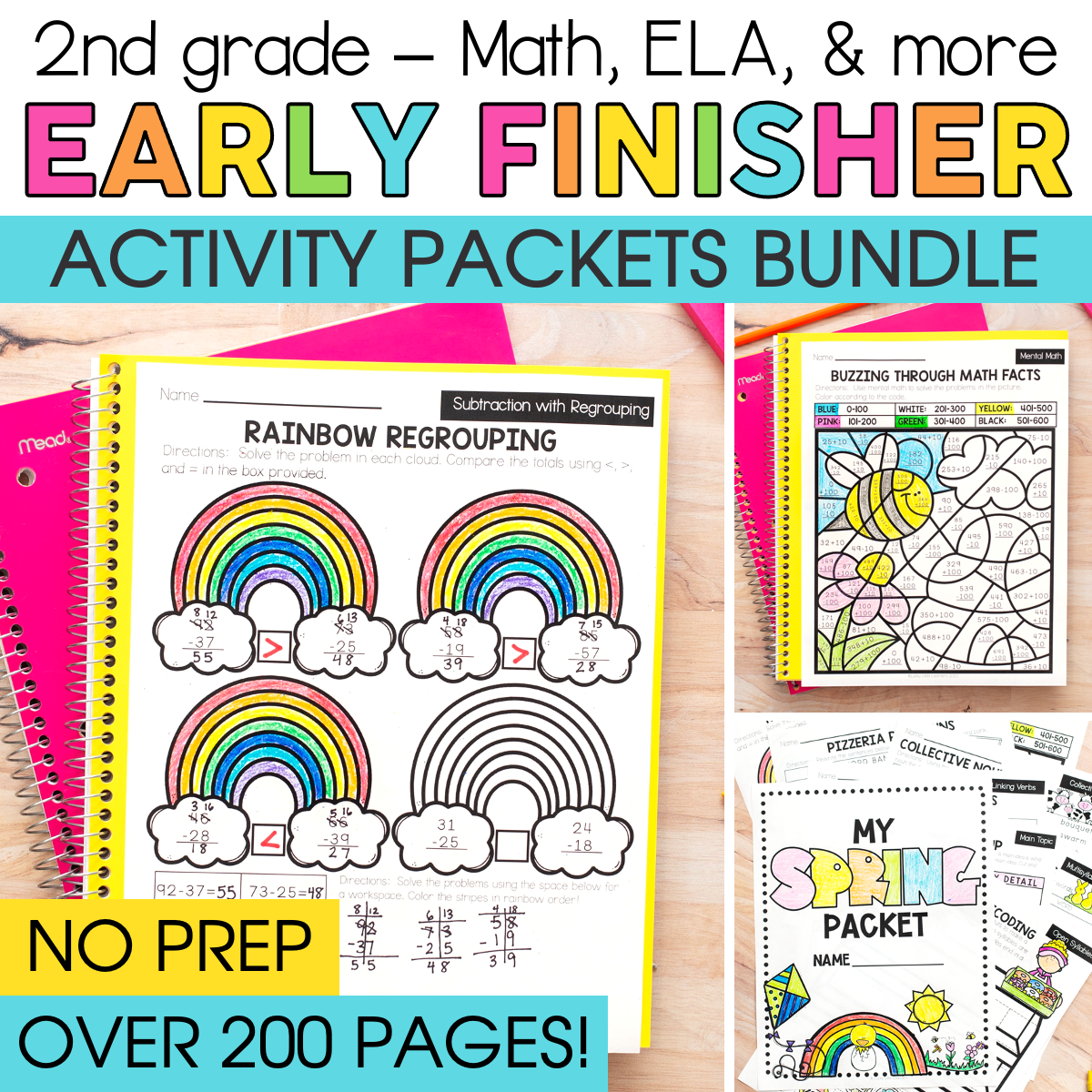
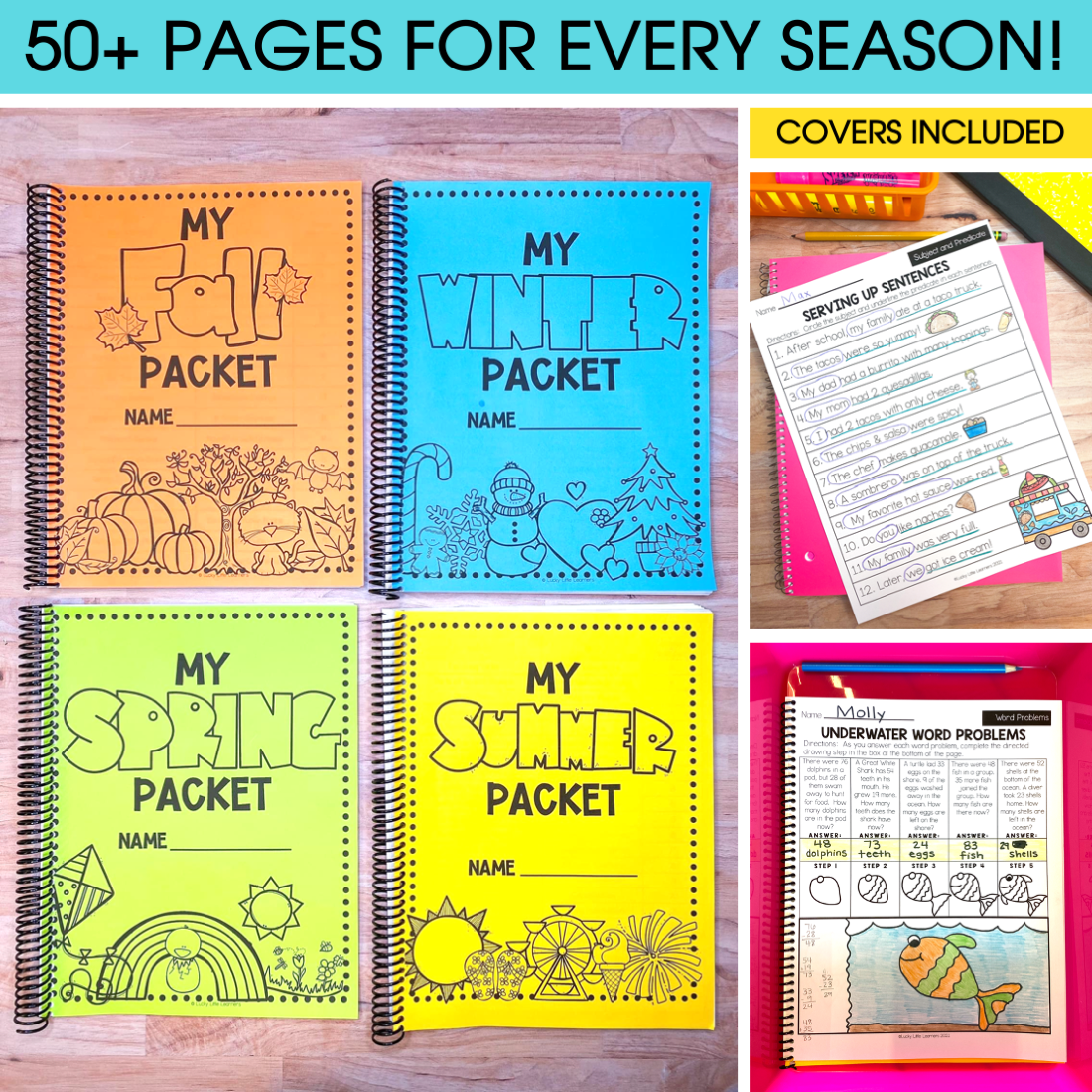
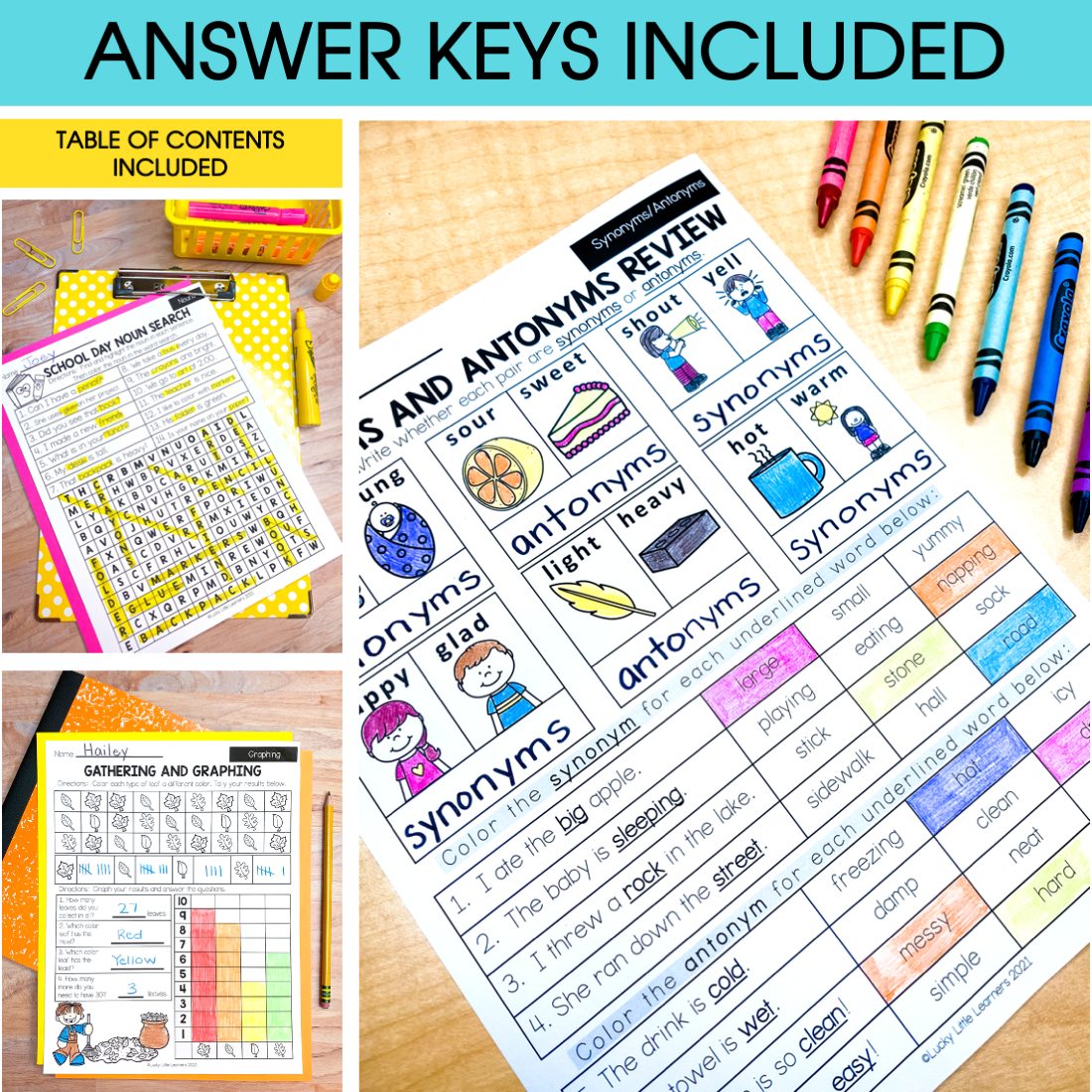
These no-prep packets with engaging pages have fun & easy activities for early finishers! Each worksheet targets a math, ELA, science, social studies, art, or SEL skill. This helps students review content in a fun way!
Need no-prep early finisher activities?
The worksheets can be printed & stapled into a packet. Students can keep it in their desks ready to go!
Want students to work on something purposeful?
Each worksheet targets a skill that aligns with important content. Students will be reviewing previously learned concepts.
Students not engaged in their work?
Every page is exciting and engaging. The themes & activities keep students wanting more!
CCSS
2.MD.A.1
Measure the length of an object by selecting and using appropriate tools such as rulers, yardsticks, meter sticks, and measuring tapes.
CCSS
2.MD.A.2
Measure the length of an object twice, using length units of different lengths for the two measurements; describe how the two measurements relate to the size of the unit chosen.
CCSS
2.MD.A.3
Estimate lengths using units of inches, feet, centimeters, and meters.
CCSS
2.MD.A.4
Measure to determine how much longer one object is than another, expressing the length difference in terms of a standard length unit.
CCSS
2.MD.B.5
Use addition and subtraction within 100 to solve word problems involving lengths that are given in the same units, e.g., by using drawings (such as drawings of rulers) and equations with a symbol for the unknown number to represent the problem.
CCSS
2.MD.B.6
Represent whole numbers as lengths from 0 on a number line diagram with equally spaced points corresponding to the numbers 0, 1, 2,…, and represent whole-number sums and differences within 100 on a number line diagram.
CCSS
2.MD.C.7
Tell and write time from analog and digital clocks to the nearest five minutes, using a.m. and p.m.
CCSS
2.MD.C.8
Solve word problems involving dollar bills, quarters, dimes, nickels, and pennies, using $ and ¢ symbols appropriately. Example: If you have 2 dimes and 3 pennies, how many cents do you have?
CCSS
2.MD.D.9
Generate measurement data by measuring lengths of several objects to the nearest whole unit, or by making repeated measurements of the same object. Show the measurements by making a line plot, where the horizontal scale is marked off in whole-number units.
CCSS
2.MD.D.10
Draw a picture graph and a bar graph (with single-unit scale) to represent a data set with up to four categories. Solve simple put-together, take-apart, and compare problems using information presented in a bar graph.
CCSS
2.NBT.A.1
Understand that the three digits of a three-digit number represent amounts of hundreds, tens, and ones; e.g., 706 equals 7 hundreds, 0 tens, and 6 ones. Understand the following as special cases:
CCSS
2.NBT.A.1a
100 can be thought of as a bundle of ten tens – called a “hundred.”
CCSS
2.NBT.A.1b
The numbers 100, 200, 300, 400, 500, 600, 700, 800, 900 refer to one, two, three, four, five, six, seven, eight, or nine hundreds (and 0 tens and 0 ones).
CCSS
2.NBT.A.2
Count within 1000; skip-count by 5s, 10s, and 100s.
CCSS
2.NBT.A.3
Read and write numbers to 1000 using base-ten numerals, number names, and expanded form.
CCSS
2.NBT.A.4
Compare two three-digit numbers based on meanings of the hundreds, tens, and ones digits, using >, =, and < symbols to record the results of comparisons.
CCSS
2.NBT.B.5
Fluently add and subtract within 100 using strategies based on place value, properties of operations, and/or the relationship between addition and subtraction.
CCSS
2.NBT.B.6
Add up to four two-digit numbers using strategies based on place value and properties of operations.
CCSS
2.NBT.B.7
Add and subtract within 1000, using concrete models or drawings and strategies based on place value, properties of operations, and/or the relationship between addition and subtraction; relate the strategy to a written method. Understand that in adding or subtracting three-digit numbers, one adds or subtracts hundreds and hundreds, tens and tens, ones and ones; and sometimes it is necessary to compose or decompose tens or hundreds.
CCSS
2.NBT.B.8
Mentally add 10 or 100 to a given number 100–900, and mentally subtract 10 or 100 from a given number 100–900.
CCSS
2.NBT.B.9
Explain why addition and subtraction strategies work, using place value and the properties of operations.
CCSS
2.OA.A.1
Use addition and subtraction within 100 to solve one- and two-step word problems involving situations of adding to, taking from, putting together, taking apart, and comparing, with unknowns in all positions, e.g., by using drawings and equations with a symbol for the unknown number to represent the problem.
CCSS
2.OA.B.2
Fluently add and subtract within 20 using mental strategies. By end of Grade 2, know from memory all sums of two one-digit numbers.
CCSS
2.OA.C.3
Determine whether a group of objects (up to 20) has an odd or even number of members, e.g., by pairing objects or counting them by 2s; write an equation to express an even number as a sum of two equal addends.
CCSS
2.OA.C.4
Use addition to find the total number of objects arranged in rectangular arrays with up to 5 rows and up to 5 columns; write an equation to express the total as a sum of equal addends.
CCSS
2.G.A.1
Recognize and draw shapes having specified attributes, such as a given number of angles or a given number of equal faces. Identify triangles, quadrilaterals, pentagons, hexagons, and cubes.
CCSS
2.G.A.2
Partition a rectangle into rows and columns of same-size squares and count to find the total number of them.
CCSS
2.G.A.3
Partition circles and rectangles into two, three, or four equal shares, describe the shares using the words halves, thirds, half of, a third of, etc., and describe the whole as two halves, three thirds, four fourths. Recognize that equal shares of identical wholes need not have the same shape.
CCSS
RF.2.3
Know and apply grade-level phonics and word analysis skills in decoding words.
CCSS
RF.2.3a
Distinguish long and short vowels when reading regularly spelled one-syllable words.
CCSS
RF.2.3b
Know spelling-sound correspondences for additional common vowel teams.
CCSS
RF.2.3c
Decode regularly spelled two-syllable words with long vowels.
CCSS
RF.2.3d
Decode words with common prefixes and suffixes.
CCSS
RF.2.3e
Identify words with inconsistent but common spelling-sound correspondences.
CCSS
RF.2.3f
Recognize and read grade-appropriate irregularly spelled words.
CCSS
W.2.1
Write opinion pieces in which they introduce the topic or book they are writing about, state an opinion, supply reasons that support the opinion, use linking words (e.g., because, and, also) to connect opinion and reasons, and provide a concluding statement or section.
CCSS
W.2.2
Write informative/explanatory texts in which they introduce a topic, use facts and definitions to develop points, and provide a concluding statement or section.
CCSS
W.2.3
Write narratives in which they recount a well-elaborated event or short sequence of events, include details to describe actions, thoughts, and feelings, use temporal words to signal event order, and provide a sense of closure.
CCSS
W.2.5
With guidance and support from adults and peers, focus on a topic and strengthen writing as needed by revising and editing.
CCSS
W.2.6
With guidance and support from adults, use a variety of digital tools to produce and publish writing, including in collaboration with peers.
CCSS
W.2.8
Recall information from experiences or gather information from provided sources to answer a question.
CCSS
L.2.1
Demonstrate command of the conventions of standard English grammar and usage when writing or speaking.
CCSS
L.2.1a
Use collective nouns (e.g., group).
CCSS
L.2.1b
Form and use frequently occurring irregular plural nouns (e.g., feet, children, teeth, mice, fish).
CCSS
L.2.1c
Use reflexive pronouns (e.g., myself, ourselves).
CCSS
L.2.1d
Form and use the past tense of frequently occurring irregular verbs (e.g., sat, hid, told).
CCSS
L.2.1e
Use adjectives and adverbs, and choose between them depending on what is to be modified.
CCSS
L.2.1f
Produce, expand, and rearrange complete simple and compound sentences (e.g., The boy watched the movie; The little boy watched the movie; The action movie was watched by the little boy).
CCSS
L.2.2
Demonstrate command of the conventions of standard English capitalization, punctuation, and spelling when writing.
CCSS
L.2.2a
Capitalize holidays, product names, and geographic names.
CCSS
L.2.2b
Use commas in greetings and closings of letters.
CCSS
L.2.2c
Use an apostrophe to form contractions and frequently occurring possessives.
CCSS
L.2.2d
Generalize learned spelling patterns when writing words (e.g., cage -> badge; boy -> boil).
CCSS
L.2.2e
Consult reference materials, including beginning dictionaries, as needed to check and correct spellings.
CCSS
L.2.3
Use knowledge of language and its conventions when writing, speaking, reading, or listening.
CCSS
L.2.3a
Compare formal and informal uses of English.
CCSS
L.2.4
Determine or clarify the meaning of unknown and multiple-meaning words and phrases based on grade 2 reading and content, choosing flexibly from an array of strategies.
CCSS
L.2.4a
Use sentence-level context as a clue to the meaning of a word or phrase.
CCSS
L.2.4b
Determine the meaning of the new word formed when a known prefix is added to a known word (e.g., happy/unhappy, tell/retell).
CCSS
L.2.4c
Use a known root word as a clue to the meaning of an unknown word with the same root (e.g., addition, additional).
CCSS
L.2.4d
Use knowledge of the meaning of individual words to predict the meaning of compound words (e.g., birdhouse, lighthouse, housefly; bookshelf, notebook, bookmark).
CCSS
L.2.4e
Use glossaries and beginning dictionaries, both print and digital, to determine or clarify the meaning of words and phrases.
CCSS
L.2.5
Demonstrate understanding of word relationships and nuances in word meanings.
CCSS
L.2.5a
Identify real-life connections between words and their use (e.g., describe foods that are spicy or juicy).
CCSS
L.2.5b
Distinguish shades of meaning among closely related verbs (e.g., toss, throw, hurl) and closely related adjectives (e.g., thin, slender, skinny, scrawny).
CCSS
L.2.6
Use words and phrases acquired through conversations, reading and being read to, and responding to texts, including using adjectives and adverbs to describe (e.g., When other kids are happy that makes me happy).
Great independent practice
This resource is jam packed with attractive and engaging worksheets for extra practice. Thank you! – Amber D.
Great Product!
I absolutely love this packet! My kids really like the variety of activities to participate in. It is also a great review of skills at the beginning and throughout the year. – Emily M.
Your license is for one teacher/classroom; please share the product link so other teachers can purchase their own copy.
After checkout you’ll get a download link on the order confirmation page and by email, and you can always re‑download from your account under My Account → Downloads.
No, this is a one‑time purchase and you keep ongoing access to the resource in your account.
Tia McHugh –
This teacher-created worksheet was a game-changer for my second grade class! It improved engagement significantly, and my students participated more actively during lessons. The clear layout and relevant activities kept them focused and excited to learn. Best of all, it saved me valuable prep time, allowing me to focus on other classroom needs. I highly recommend it to fellow educators looking for quality, ready-to-use resources!
Jodi Lynn B. –
This was useful, but I wish I could have gotten just the math sections, and not everything else.
Pink Flamingo Learning –
This worked well for my second grade class. Thanks!
Angie –
Hey there,
Thanks for leaving feedback! It’s really important to me that everything in our store improves your teaching life!
Since you enjoyed this resource, you’re going to love our weekly emails! These emails are filled with freebies and sale alerts. Click here to sign up: https://luckylittlelearners.lpages.co/i-want-weekly-freebies/
Thank you for being part of our community of educators!
– Angie Olson
Lucky Little Learners
Alexandrah A. –
This is a great resource to use as independent, or partner, work for students.
Brianna K. –
Nice resource for early finishers! Engaging enough that students are interested enjoy doing these.
Monique G. –
Having prep for early finishers is so helpful and this is a big bundle and it helped keep the kids practicing but also adding fun to it
Tammy A. –
This was perfect for students who finish early. It can be used for any subject.
Kaitlin N. –
I love this resource for my 2nd grade students! They enjoy the worksheets and even ask for more 🙂